PROJECTS
Book project
Arms, news, and lobbying: the remaking of the middle east regional (dis)order
Arms, News, and Lobbying examines the struggle over the Middle East regional order after the Arab Uprisings through arms deals, news coverage, and political lobbying. Foregrounding two scenes that reshaped Middle Eastern politics in the 2010s—Egypt after the 2013 coup and Qatar during the 2017-21 crisis—the book tells a broader story of rivalries and alignments, extending from the domestic through the regional to the global, that reshaped regional order. Arms, News, and Lobbying argues that the struggle over the Middle East was a struggle for recognition. Regional players strived to be recognised, to have their self-identities as legitimate regimes and benevolent regional powers acknowledged by relevant others. Centring Egypt’s and Qatar’s recognition concerns, the book moves the focus away from dominant powers’ role in regional politics and departs from the assumption that states consistently act out of motivations to increase their material power. To untangle dialectics of order and disorder in the Middle Eastern 2010s, Arms, News, and Lobbying uncovers an array of primary sources, offering original analyses of military procurement, media discourse, and lobbying documentation by the US Department of Justice not studied in previously published literature. The book also relies on interviews I conducted with US government officials who have occupied positions in Congress, the White House, the Department of State, and the Department of Defence. Arms, News, and Lobbying thus offers a fresh perspective on the remaking of the Middle Eastern order, unpacking how the struggle over regional order ultimately yielded further regional disorder.
SPECIAL ISSUE IN MIDDLE EAST CRITIQUE
RETHINKING ‘STATE’ AND ‘REGIME’ IN THE MIDDLE EAST AND NORTH AFRICA: CONCEPTUAL, HISTORICAL, AND METHODOLOGICAL CLARIFICATIONS
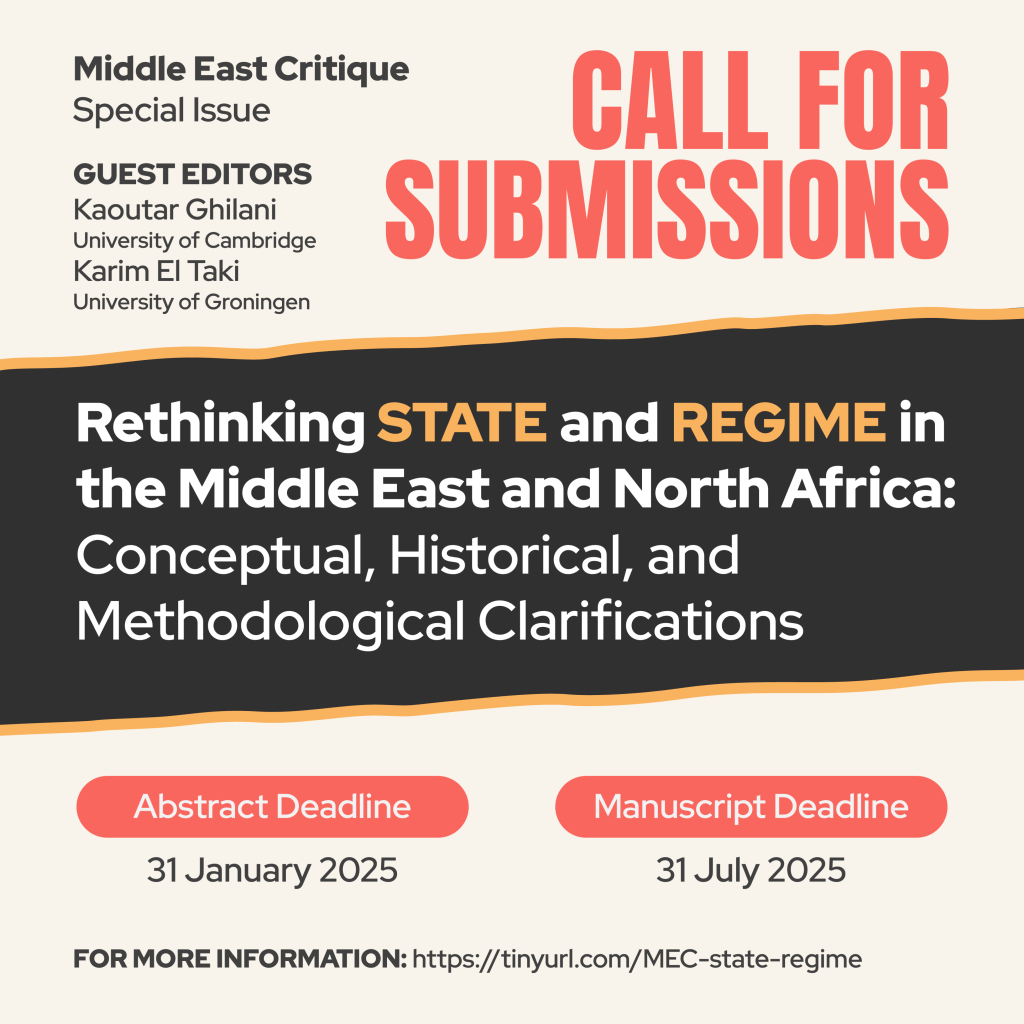
This special issue addresses the persistent conceptual confusion around ‘state’ and ‘regime’ in academic literature on the modern Middle East and North Africa (MENA). Much of the existing scholarship on the region has deployed these terms short of a conceptual distinction effort. Notions such as the ‘deep state’ (al-dawla al-ʿamīqa) are commonly used inside and outside academia to refer to some configuration of institutional and power relations that blur the lines between state and regime. Similarly, usages of ‘al-makhzan’ in Morocco, ‘le pouvoir’ in Algeria, or ‘al-sulṭa’ in Lebanon, seem to reproduce political discourses that may obscure more than they reveal. It remains unclear whether these terms describe varieties of the same political reality or entirely distinct phenomena.
Rather than presupposing that the conflation of regime and state in the literature on the MENA is necessarily a conceptual flaw, this special issue interrogates it to unpack its multiples dimensions. If the state/regime distinction is one with a difference, as the two distinct terms suggest, where does the difference lie and why have these concepts been conflated in the scholarship on the MENA? Conversely, if it is a distinction without a difference, how could we, as scholars, refine our conceptual usages to ensure historical accuracy and political relevance? Alternatively, it may be that the conflation of the two terms is productive. In that sense, the issue is not that scholars are ‘unable’ to see the difference, but that empirically there are interpenetrations between states and regimes.
Centring the blurred boundaries of state and regime in scholarship on the MENA, this special issue aims to explore their origins, the mechanisms of their reproduction, and the intellectual and political ramifications of this conflation. The goal is to advance new critical ways to understand it and methodological innovations to tackle it. In other words, this special issue weaves together an intellectual history of power and a political history of knowledge in the MENA by questioning the distinction between ‘state’ and ‘regime.’ Interrogating the confusion between these two concepts is not a matter of superficial intellectualism; it has significant analytical and political implications. Analytically, this special issue seeks to clarify what we are talking about, how it is talked about, where agency lies, and what hegemonic namings of and references to ‘power’ show and obscure. Studies on legitimacy, in particular, have suffered from this conceptual overlap, with symbols of the nation, figures of the regime, and state institutions often being examined through an indistinguishable vocabulary of regime/state/national legitimation. Politically, this special issue acknowledges the performative power of language and unpacks practices of knowledge production that perpetuate established patterns of domination.
ARTICLE PROJECT
CIRCUMVENTING THE AUTHORITARIAN CHALLENGE: LOBBYING AND THE STUDY OF MIDDLE EASTERN IR
The aftermath of the Arab Uprisings witnessed a fierce contestation among Middle Eastern states to redefine the regional order. Increasing projections of power, whether military or diplomatic, created new research avenues for scholars of the Middle East. However, the same period was characterised by a resurgence of authoritarianism in the counter-revolutionary turn following the uprisings, creating new challenges for researchers. Across the region, they have been harassed, detained, prosecuted, and even killed for the simple reason of being perceived as suspicious. In such a context where the field is increasingly inaccessible and ethical concerns are urgent, how can we study Middle Eastern states’ foreign relations? This paper offers a methodological reflection on the research of the international relations of the Middle East. Of course, it does not purport to offer a comprehensive examination of the myriad ways one can circumvent the authoritarian challenge in the study of Middle Eastern IR. Instead, it builds on the author’s research about Egyptian and Qatari foreign policies, centring the practice of lobbying as a lens to examine regional dynamics. Indeed, the decade following the uprisings also witnessed a surge in Arab governments’ investment in lobbying the United States. They exported their contestation of regional order to the halls of government in Washington DC. Studying lobbying practices, I argue, allows us not only to circumvent the authoritarian challenge but also to build new questions for further research.
 Karim El Taki